
Union Minister Ashwini Vaishnaw indicates India may require a new legal framework for Artificial Intelligence, as the current IT law predates AI's rapid emergence. The government aims to balance innovation with regulation, engaging with the industry to ensure citizen safety while fostering technological growth.

Railway Minister Ashwini Vaishnaw asserted that the BJP will form the government in West Bengal after the upcoming assembly elections, ending the Trinamool Congress's 15-year rule. He criticised the TMC for vote-bank politics, hindering development, and failing to protect women, while promising unprecedented development under a BJP government.
Union IT Minister Ashwini Vaishnaw reiterated India's commitment to becoming the world's artificial intelligence (AI) application capital. This focus comes amidst a global downturn in AI stocks, with Vaishnaw acknowledging the industry's rapidly changing environment. India aims to deploy AI across various sectors for large-scale transformation.

Union Minister Ashwini Vaishnaw announced that the Indian government will release a draft consultation paper on Artificial Intelligence (AI) regulations within the next 30 days, focusing on safety, a human-first approach, skilling, inclusivity, and harm restriction.

Railway Minister Ashwini Vaishnaw announced that India's first high-speed rail service will begin in the last quarter of 2027, with the Surat to Vapi section opening first. He provided updates on significant construction progress, including pier and viaduct work, noise barrier installation, and tunnel excavation. The minister also highlighted the country's first undersea rail tunnel and indigenous manufacturing efforts for bullet train sets and infrastructure components, while addressing past project delays.

The 51-year-old BJP leader Vaishnaw, born in Rajasthan's Jodhpur, is a suave and former Odisha cadre IAS officer from the 1994 batch. He managed to wrangle support from the ruling BJD president and Chief Minister Naveen Patnaik despite being in the rival camp.
The change in leadership at the railway ministry comes at a time when the national transporter is grappling with low passenger earnings even as it is trying to increase freight loading and open up its doors to private investment. Union Minister Ashwini Vaishnaw took charge from Piyush Goyal who got the railway portfolio in 2017 after Prime Minister Narendra Modii dropped Suresh Prabhu from the Union Cabinet. Completing freight corridors, negotiating land for the bullet train, and speeding up monetisation plans would be some of the major focus areas for Vaishnaw.

Railway Minister Ashwini Vaishnaw announced the approval of the north corridor of the bullet train project by Prime Minister Narendra Modi, highlighting its 'Make in India' aspect and potential to transform lives. The corridor will connect major cities from Delhi to Guwahati, significantly reducing travel times. Vaishnaw also launched new Vande Bharat Sleeper Express and MEMU services in Varanasi, while criticising previous governments' railway budgets for Uttar Pradesh.

Union Minister Ashwini Vaishnaw chaired a meeting focusing on Artificial Intelligence, emerging technologies, and electronics hardware manufacturing, highlighting India's progress and future roadmap in these sectors.
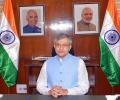
From trusted bureaucrat, to Wharton, MNC executive to businessman, and now politician, the man in charge of two weighty ministries is a unique all-rounder with specialist knowledge.

Black money to the tune of "Rs 1.25 lakh crore" has been confiscated by the Modi government, Union Minister Ashwini Vaishnaw said on Monday and asserted transparency is a key aspect of the present dispensation's good governance model. The minister for railways said similarly, to ensure transparency, benami properties worth Rs 4,300 crore were attached and registration of 1.75 lakh companies cancelled. Talking to reporters at the Rail Bhawan, Vaishnaw said in his long public service, Prime Minister Narendra Modi has "perfected a model of good governance that started in Gujarat".
IT Minister Ashwini Vaishnaw announced that the Indian government will release a consultation paper on AI regulations within a month. This framework will address critical aspects like AI safety, deepfakes, and a human-first approach, emphasising the industry's primary responsibility in ensuring safe AI deployment. The move comes amidst growing global concerns over AI risks and the need for robust safeguards.
Union Minister Ashwini Vaishnaw warned of increased global turbulence from tech disruptions, AI, and financial risks in the coming years. He stated that India is strengthening its economic and technological resilience to protect its growth from external shocks. India is focusing on domestic manufacturing and design in critical tech areas while maintaining global integration, with trust becoming as crucial as cost in supply chains.

The Union Cabinet has approved a 3 per cent increase in Dearness Allowance (DA) and Dearness Relief (DR) for over 1.17 crore central government employees and pensioners, effective from July 1, 2026, ahead of Diwali.

India's IT Ministry sources state the country will not slow down its Artificial Intelligence development, distinguishing its focus on people-centric applications from global concerns over frontier models. The government acknowledges AI safety risks and is tightening incident reporting norms, with IT Minister Ashwini Vaishnaw emphasising regulation for user safety.
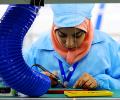
India has launched the ~62,500 crore Mobile Phone Manufacturing Scheme (MPMS) to incentivise domestic production and strengthen Indian mobile phone brands, offering production-linked incentives and additional benefits for local component sourcing.

India's IT Secretary S Krishnan announced that the government is considering a dedicated regulatory framework for Artificial Intelligence, moving beyond existing IT rules to address challenges like deepfakes and synthetic content. This comes as global policymakers grapple with AI's rapid emergence and its implications.

The government is going to bring a regulation on deepfakes soon that will take help of technology for efficient implementation, Union electronics and IT minister Ashwini Vaishnaw said on Saturday.
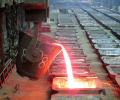
The Indian government has approved a Rs 2,814 crore capital expenditure support scheme to promote domestic processing of critical minerals like lithium and nickel. This five-year scheme, running until 2030-31, aims to reduce import dependence, develop value chains, and enhance India's self-reliance in essential materials for clean energy and modern technologies. It includes a 30% capital subsidy for setting up processing plants.

Union Minister Ashwini Vaishnaw announced that two more semiconductor chip packaging units, part of the India Semiconductor Mission, are expected to be operational by July and December, respectively. He also highlighted India's focus on becoming a beneficiary of AI technology, expanding data centre infrastructure with significant investments, and developing new subsea cable networks for global connectivity.

India's IT Minister Ashwini Vaishnaw has directed officials to summon Meta regarding Instagram ads promoting child sexual abuse material, following a BBC investigation. This action comes shortly after the government also questioned Meta about WhatsApp's planned username feature, citing concerns over increased online fraud and cybercrimes.

The Indian Cabinet has approved Fairfax Financial Holdings' Rs 52,878 crore bid to acquire a 60.72 per cent stake in IDBI Bank, marking the country's largest foreign direct investment in the financial sector.

The government is questioning the visiting Meta team on whether the company is adhering to the law of the land, following summons to the social media giant over temporary restriction of Prime Minister Narendra Modi's Facebook post recently, sources said on Thursday.

Railway Minister Ashwini Vaishnaw will inaugurate the underground tunnel-boring work from Vikhroli to the Bandra Kurla Complex station in Mumbai on Sunday, marking the maiden use of a tunnel boring machine for the country's first bullet train project, between Mumbai and Ahmedabad.

The Indian government has announced a significant overhaul of the Agnipath scheme, offering all Agniveers an additional two-year extension period and a subsequent pathway to permanent recruitment in the armed forces, subject to eligibility and consent.

'Details of accounts such as the name, email id associated with the account, the IP address will now be shared with law enforcement agencies, which will help track down offenders faster.'
Airtel Business CEO Sharat Sinha stated that evolving architecture and methodologies for safely deploying Artificial Intelligence, coupled with adequate guardrails, are essential to unlock productivity gains. He welcomed the government's upcoming consultation paper on AI regulation, focusing on safety, deepfakes, and a human-first approach. Sinha also highlighted AI's role in driving demand for digital infrastructure and Airtel's growth in cybersecurity and fraud prevention.

The Vande Bharat Express has successfully achieved a speed of 100 kmph over the world's highest Chenab Railway Bridge and India's first cable-stayed Anji Bridge. This significant speed enhancement on the 111-km Katra-Banihal section of the Udhampur-Srinagar-Baramulla Railway Link project will reduce travel time and improve rail connectivity to the Kashmir Valley.

Search engine major Google will also start sharing details of child sexual abuse cases and repeat offenders with the cybercrime division of the Indian Cybercrime Coordination Centre (I4C) of the Ministry of Home Affairs.

Ahead of Gandhi Jayanti, People for the Ethical Treatment of Animals India (PETA India) has sent a letter to Union Minister for Information and Broadcasting Ashwini Vaishnaw calling for a nationwide prohibition on billboards, television, online and other advertisements for meat, beginning on October 2.
Senior executives from Meta, the parent company of Facebook, Instagram, and WhatsApp, appeared before India's child rights body, NCPCR, for questioning regarding alleged advertisements promoting child sexual exploitative and abuse material (CSEAM) on its platforms. This follows a BBC report and a stern notice from the Ministry of Electronics and Information Technology (MeitY) to Meta over the issue.

Cyclone Arnab has triggered heavy to extremely heavy rainfall across southern Odisha, leading to the evacuation of over 30,000 people and a high alert in several districts. The cyclone, which weakened after making landfall in Andhra Pradesh, has disrupted train services and prompted extensive disaster preparedness measures.

Chinese President Xi Jinping notably skipped a gala dinner hosted by Prime Minister Narendra Modi for BRICS leaders and other dignitaries, with sources suggesting he returned to his hotel to rest. Meanwhile, a grand cultural performance, 'BRICS Symphony - One Rhythm, Many Cultures', featuring artistes from member countries, was a highlight of the evening.

Modi inaugurated the Semicon India 2025 in Delhi, in the presence of Chief Minister Rekha Gupta, and Union Minister of Commerce and Industry Jitin Prasada.

The Finance Ministry's expenditure department has approved a substantial Rs 1.25 lakh crore outlay for India Semiconductor Mission 2.0, significantly increasing the country's investment in global chip-making ambitions and aiming to establish India as a major semiconductor hub.
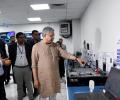
'I think that kind of change is coming. We should stay prepared for that change, whichever industry or sector we are in, we must be prepared.'

The Union Cabinet has approved a significant increase in the mandatory EPFO wage ceiling from Rs 15,000 to Rs 25,000 per month, a move expected to bring over 51 lakh additional employees under mandatory social security coverage.

India is strategically positioned to develop a robust domestic semiconductor ecosystem, driven by increasing electronics consumption, strong government support through incentives, and a global shift in supply chains. Boston Consulting Group Managing Director Ankush Wadhera highlights India's potential as a safe haven for investments, with the AI boom further fuelling demand for advanced chips. The nation aims to expand its capabilities across the entire semiconductor value chain, attracting significant global and domestic investments.

The government has issued a stern notice to Meta on Child Sexual Exploitative and Abuse Material (CSEAM) in paid advertisements on Instagram, sources said on Sunday.

Industry experts advocate for India to develop its own artificial intelligence (AI) safety framework, distinct from US or EU models, to address unique challenges like deepfakes and cyberattacks. They call for a comprehensive commitment involving all stakeholders and a hybrid regulatory approach combining voluntary and binding measures, as the Indian government also considers new AI regulations.
